


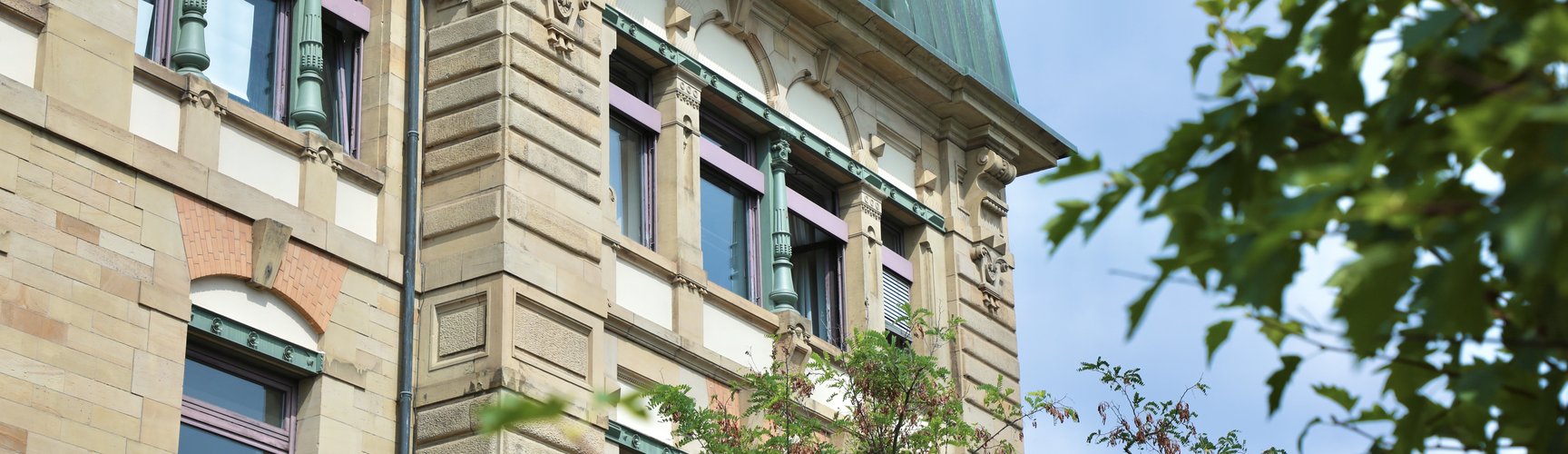
University
Our university sees itself as a vibrant educational institution that is accessible to everyone who wishes to play an active role in shaping the society of tomorrow.
This page provides an overview of our university’s organisational structures. You will learn about the governing bodies, the administrative structure and the two faculties, and gain an overview of our central and academic departments as well as key points of contact.
You will learn about our key priorities, how we are developing the university to be fit for the future, ensuring the quality of teaching, and building international networks. Our legal framework is also available via quick access.
-
170:
research staff
-
3.500:
students
-
50:
university lecturers
-
140:
other staff members
Our profile
As a university specialising in educational sciences with the right to award doctorates and habilitations, we teach and conduct research into educational processes both within and outside schools.
-
 Getting to know the profile fields
Three profile fields
We have identified three key areas as strategic priorities in our structural and development plan. The academic staff at our university collaborate in these areas both across disciplines and departments and with external partners.
-
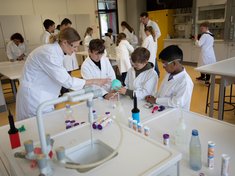 Find out more about the teaching and learning labs
Teaching and learning labs
The teaching and learning labs play a special role, acting as a bridge between academia and practice. There, our students acquire key educational skills for their future careers, whilst teachers and school classes, in turn, benefit from new educational approaches.
Management and organisation
Behind every institution are dedicated people. Our approximately 3,500 students are supported by 50 professors and 170 academic and research staff.
-
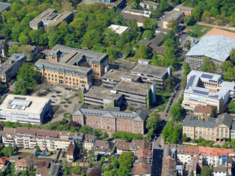 An overview of all organisational units
Institutions, bodies and interest groups
The Rector’s Office, the University Council and the Senate set the course for the future of our university. Teaching and research are carried out by the two faculties. Other departments perform key functions, whilst 140 administrative staff work behind the scenes. Our student representatives and officers play a special role. They represent the interests of specific groups or individuals within the university.
-
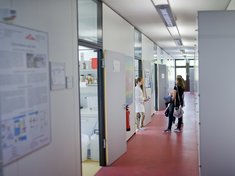
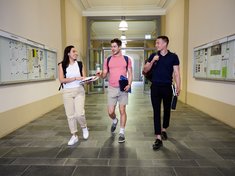 Continue to Faculty A
Faculty of Arts and Humanities
Within the university, the faculty is often simply referred to as “Faculty A”. On this page, you will find an overview of the departments that belong to the faculty, as well as a list of committees and staff members.
-
 Continue to Faculty B
Faculty of Natural and Social Sciences
Within the university, the faculty is often referred to simply as “Faculty B”. On this page, you will find an overview of the departments that belong to the faculty, as well as a list of committees and staff members.
Partnerships and exchanges
We have close links with the other higher education institutions in Karlsruhe. Our joint initiatives include the Karlsruhe School of Education, shared advisory services, research projects and doctoral programmes, as well as a Master’s degree programme for teacher training at vocational schools.
-
 Find out more
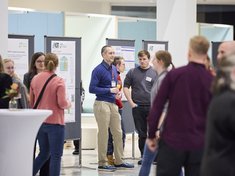
The Karlsruhe School of Education (KSE)
The KSE is an inter-university research institution established in partnership with the Karlsruhe Institute of Technology (KIT). At the KSE, teacher training is strengthened and further developed through the integration of the strengths of both universities, with a focus on subject-specific disciplines, subject didactics and educational sciences, as well as practical school placements.
The major European mobility programme “Erasmus+” promotes exchanges of students, lecturers and other higher education staff between European universities and a number of other partner countries. We also collaborate with universities and higher education institutions around the world outside the Erasmus+ programme.
-
 Find out more
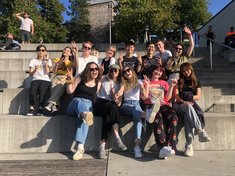
Internationalisation
Internationalisation is a key feature of many aspects of university life at our institution, encompassing not only students, teaching and research but also our administrative departments. To this end, we offer a wide range of opportunities for incoming and outgoing students. The main point of contact for this is our International Office.
Campus
-
 Discover the campus and what it has to offer
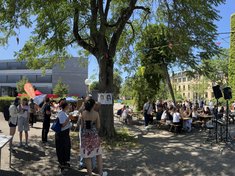
A place for the university community
The campus is where study, research, culture and the university community come together, all in close proximity yet within spacious surroundings. Its proximity to the city centre, the castle garden and the other universities in Karlsruhe makes our location particularly attractive. A wide range of activities help to strengthen the sense of community and foster a spirit of togetherness.
A brief history of the university
The roots of our university can be traced back to a teacher training college whose foundation can be documented as far back as the 18th century (first regulations dating from 1757, teacher training college established in 1768). During the 19th and early 20th centuries, teacher training in Karlsruhe developed step by step: institutions were renovated, reorganised and relocated. The institution survived the destruction of the war, particularly in 1944, and underwent several phases of reform and name changes after the Second World War.
The current Karlsruhe University of Education was formally established in 1962. Since then, we have continuously expanded our range of courses and research capabilities. Key milestones include the introduction of modern degree programmes such as the European Teacher Training programme and multilingual Master’s programmes, as well as the acquisition of the right to award doctorates and habilitations.
Today, our teaching and research focus on democratic education, inclusive pedagogy, digital educational processes, educational research and STEM subjects with a view to sustainability (ESD). We have held system accreditation since 2020.

Updated on 31 March 2026