

Lehr-Lern-Labor Informatik
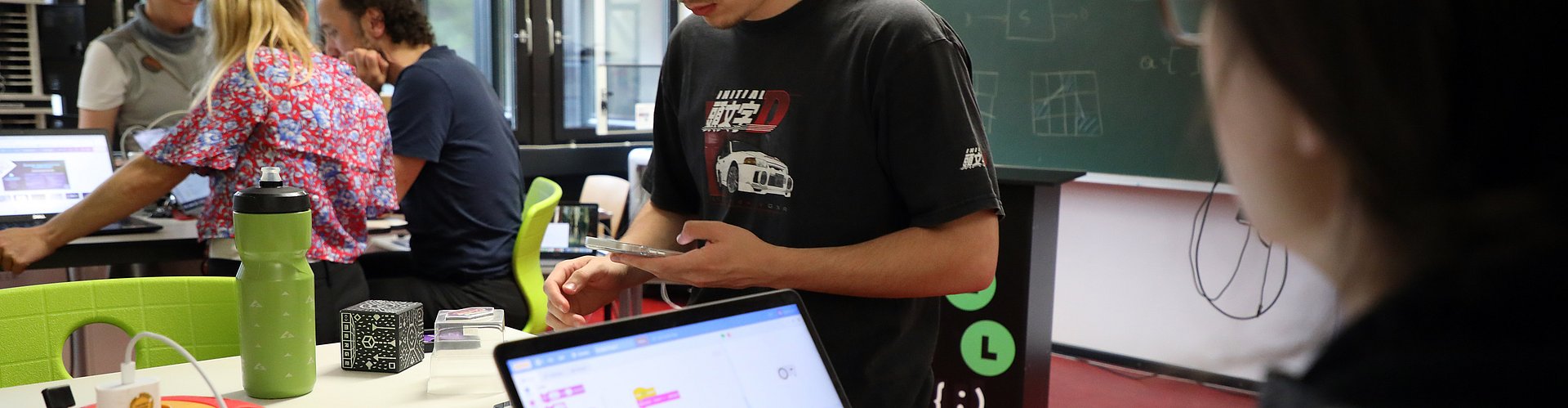
Das Lehr-Lern-Labor Informatik ist ein Lernort mit Angeboten für Lehramtsstudierende der Informatik und Schulklassen. Es verfolgt zwei Ziele: Die Integration von Praxiserfahrung in das Lehramtsstudium im Fach Informatik und die Förderung von Informatikkompetenzen bei Schüler:innen.
Dabei ist das Konzept so ausgerichtet, dass durch das Zusammenwirken von Praxiserfahrung, der Beforschung dieser und der kooperativen Zusammenarbeit mit dem KIT, eine nachhaltige Wirkung des Lehr-Lern-Labors für zukünftige Informatik-Lehrerende erzielt wird. Im Rahmen von fachdidaktischen Lehrveranstaltungen können Studierende direkt an der Hochschule Konzepte aus der Informatik praxisorientiert ausprobieren. Dadurch kann der Praxisbezug in die Lehre mit einbezogen werden und fördert somit den Professionalisierungsprozess der angehenden Informatik-Lehrer:innen.
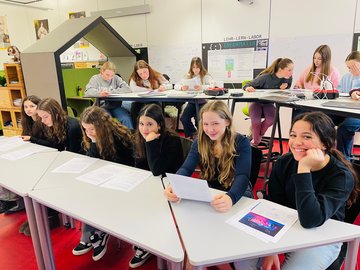
Zusätzlich zum Laborbetrieb im Rahmen des Informatikstudiums bietet unser Lehr-Lern-Labor auch Workshops für Schulklassen an. Dies bietet nicht nur Schüler:innen die Möglichkeit, sich über den Unterricht hinaus mit informatischen Themen auseinanderzusetzen. Auch Lehrkräfte profitieren von neuen Unterrichtsideen und fachlichem Input.
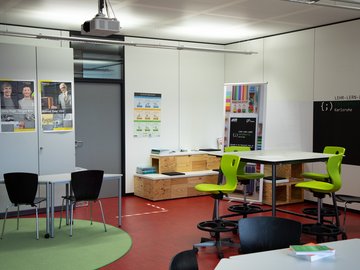
Das Lehr-Lern-Labor Informatik an der Pädagogischen Hochschule befindet sich in Gebäude 2 in Raum B.112.
Kommen Sie vorbei ins OpenLab!
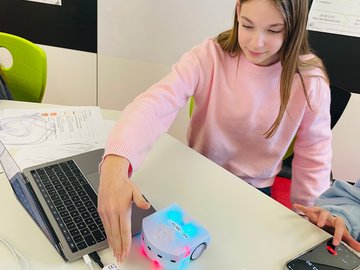
Das Lehr-Lern-Labor Informatik bietet jedes Semester ein OpenLab an, bei dem Studierende und Lehrkräfte die Möglichkeit haben, verschiedene Gadgets (Roboter, VR-Brillen, Mikrocontroller, ...) und Ideen auszuprobieren. Das OpenLab wird durch unseren studentischen Mitarbeiter Simon Wenz betreut.
Im Wintersemester 2026 findet das OpenLab während der Semesterzeiten jeden Freitag von 12:00 bis 14:00 Uhr statt.
Eine Anmeldung ist nicht erforderlich. Wir freuen uns auf Ihren Besuch!

Team
Organisation
Pädagogische Hochschule Karlsruhe
Gebäude
2
Raum
B144
Telefon
Erreichbarkeit
Nach Vereinbarung
Organisation
Pädagogische Hochschule Karlsruhe
Gebäude
2
Raum
B141
Telefon
Erreichbarkeit
Nach Vereinbarung
Studentischer Mitarbeiter
Institut für Informatik und Digitale Bildung
Studentischer Mitarbeiter
Institut für Informatik und Digitale Bildung
Alumnae
Dr. Anette Bentz, M.Sc. CS
Dr. Frauke Ritter
Das Lehr-Lern Labor Informatik an der Pädagogischen Hochschule Karlsruhe in Kooperation mit dem KIT wurde von Herbst 2019 bis Ende 2023 durch die Vector-Stiftung gefördert.
Publikationen
Oser, A., & Standl, B. (2025).Teaching and Assessing Abstraction in K‐12 Computational Thinking Education: A Systematic Literature Review. Computer Applications in Engineering Education, 33(5), https://doi.org/10.1002/cae.70073
Oser, A. (2025). Find One Solution that Solves both Problems! Algorithmic Problem-Solving with Equivalent Examples. In Proceedings of the 30th ACM Conference on Innovation and Technology in Computer Science Education V. 2 (pp. 787-787). https://doi.org/10.1145/3724389.3730788
Ritter, F. and Standl, B. (2025). "Enhancing Algorithmic Thinking Through Semantic Waves: Integrating Necessity Learning Design in Computer Science Education," 2025 IEEE Global Engineering Education Conference (EDUCON), London, United Kingdom, 2025, pp. 1-10 https://doi.org/10.1109/EDUCON62633.2025.11016370
Ritter, F. and Schlomske-Bodenstein, N. (2025). "Fostering Algorithmic Thinking within a Productive-Failure-Based Workshop Utilizing AI," 2025 IEEE Global Engineering Education Conference (EDUCON), London, United Kingdom, 2025, pp. 1-10, http://doi.org/10.1109/EDUCON62633.2025.11016641
Ritter, F. & Standl, B. (2024). "Semantic Waves: A Strategy for Algorithmic Skills in K-12 Computer Science Education". 2024 IEEE Global Engineering Education Conference (EDUCON 2024) (pp. 1-10), Kos Island, Greece. https://doi.org/10.1109/EDUCON60312.2024.10578899
Bentz, A. & Standl, B. (2023). Beyond Gender Differences: Can Scratch Programs indicate Students' Preferences?. In Proceedings of the 18th WiPSCE Conference on Primary and Secondary Computing Education Research (pp. 1-10). https://doi.org/10.1145/3605468.3609771
Bentz, A. & Standl, B. (2023). Novice Programmers Conceptions of Loops in K-12 Education in Consideration of Interest and Ability. In Proceedings of the 18th WiPSCE Conference on Primary and Secondary Computing Education Research (pp. 1-9). https://doi.org/10.1145/3605468.3605506
Ritter, F., Schlomske-Bodenstein, N., & Standl, B. (2023). Integration of an Informatics Teaching-Learning Laboratory into Pre-Service Informatics Teacher Education. Informatics in Schools. A step beyond digital education. 15th International Conference on Informatics in Schools: Situation, Evolution, and Perspectives (ISSEP 2022), Vienna, Austria. https://doi.org/10.5281/zenodo.7543522
Ritter, F., Bentz, A., & Standl, B. (2023). Promoting Algorithmic Thinking: Students Using mBots and Block-Based Programming. Practical Insights into Two Different Problem-Based Approaches. Informatics in Schools. A step beyond digital education. 15th International Conference on Informatics in Schools: Situation, Evolution, and Perspectives (ISSEP 2022), Vienna, Austria. https://doi.org/10.5281/zenodo.7543605
Bentz, A., Standl, B. (2022). Identification of pupils’ preferences of patterners and dramatists in secondary school computer science education. Discover Education 1(11). https://doi.org/10.1007/s44217-022-00011-0
Ritter, F., & Standl, B. (2022). Promoting Student Competencies in Informatics Education by Combining Semantic Waves and Algorithmic Thinking. Informatics in Education. https://doi.org/10.15388/infedu.2023.07
Ritter, F. & Standl, B. (2022). Promoting Computational Thinking in Teacher Education - Combining Semantic Waves and Algorithmic Thinking. In Proceedings of the 2022 ACM Conference on International Computing Education Research - Volume 2, ICER ’22. New York, NY, USA: Association for Computing Machinery. https://doi.org/10.1145/3501709.3544285
Bentz, A. and Standl, B. (2022). Zum Umgang Mit Heterogenität Im Lehr-Lern-Labor Informatik an der PH Karlsruhe. In 17. LeLa-Jahrestagung (LeLa 2022). Online.
Fragapane, V., & Standl, B. (2021). Work in Progress: Creative Coding and Computer Science Education – From Approach to Concept. 2021 IEEE Global Engineering Education Conference (EDUCON), 1233–1236. https://doi.org/10.1109/EDUCON46332.2021.9453951
Standl, B., Bentz, A., Ulbrich, M., Vielsack, A., & Wagner, I. (2020). Design- and Evaluation-Concept for Teaching and Learning Laboratories in Informatics Teacher Education. In K. Kori & M. Laanpere (Eds.), Informatics in Schools. Engaging Learners in Computational Thinking (ISSEP 2020) (Vol. 12518, pp. 133–145). Springer International Publishing. https://doi.org/10.1007/978-3-030-63212-0_11
Bentz, A., & Standl, B. (2020). Preliminary Experiences Towards an Inclusion of Dramatists—Teach Logic with Language (short paper). In K. Kori & M. Laanpere (Eds.), Proceedings of the International Conference on Informatics in School: Situation, Evaluation and Perspectives (ISSEP 2020) (Vol. 2755, pp. 171–175). CEUR-WS.org. http://ceur-ws.org/Vol-2755/shortpaper4.pdf
Aktualisiert am 25. März 2026 von Zentrale Webredaktion